In Dialogue: Jared O'Leary
In Dialogue: Jared O’Leary
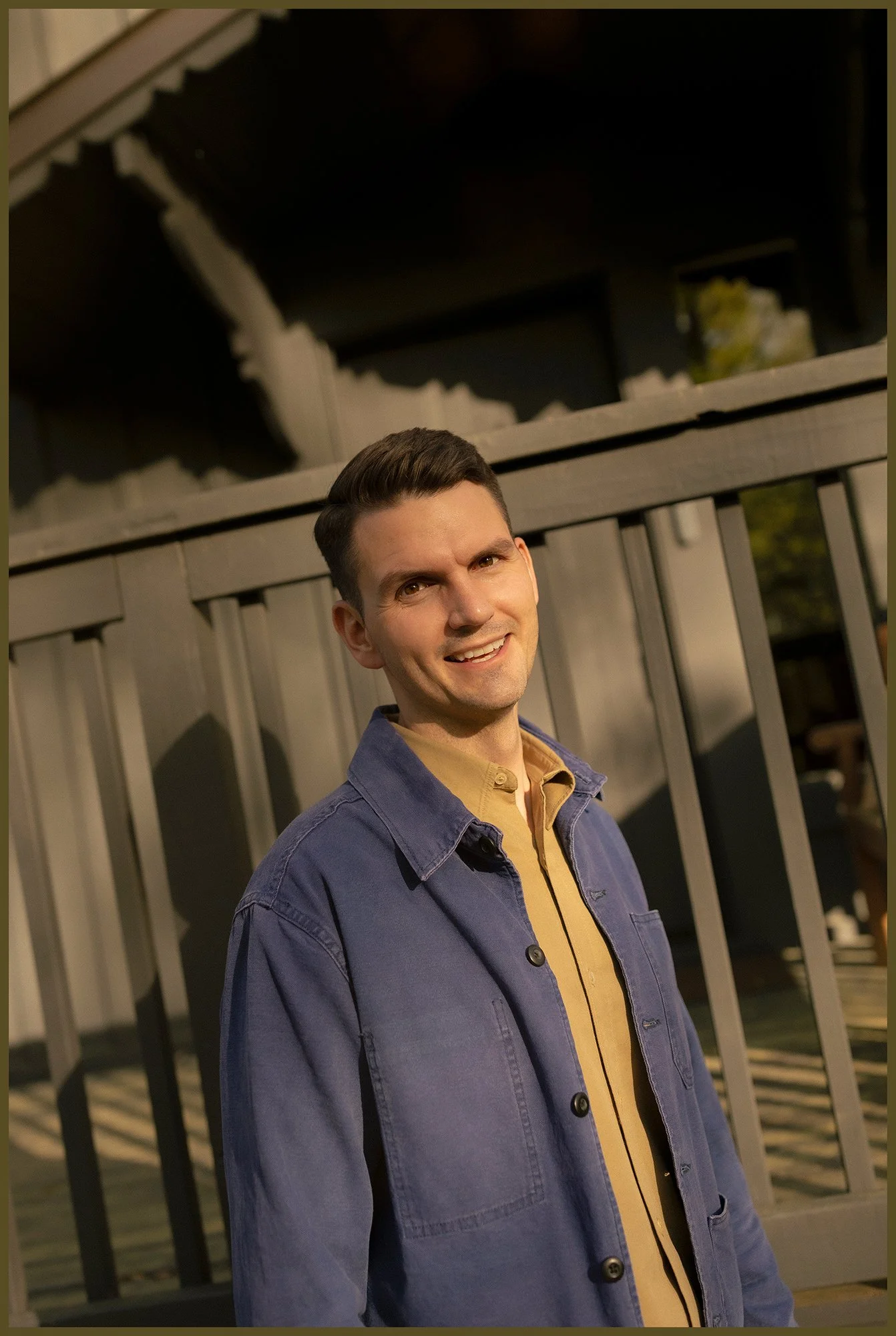
This month’s In Dialogue feature is quite meaningful. I am fortunate to welcome you into my conversation with Jared O’Leary—my partner in life, love, parenting, and Wiley Canning Company. Jared leads a quiet online life, and I am very grateful he, so thoughtfully, participated in this forward-facing interview. This experience encouraged me to interview family members, as it was deeply moving to learn more about someone I know so intimately.
Jared is my primary sounding board when planning and executing my career goals. He is willing to spend anniversary dinners and long hikes discussing Wiley Canning Company, and this generosity of time and energy has undoubtedly refined the business that exists today.
Outside of our family, Jared is an interventional cardiologist at Vanderbilt University Medical Center. He is the Program Director for Interventional Cardiology, as well as an Assistant Professor of Medicine and Medical Director for Quality at Vanderbilt Heart and Vascular Institute. Casual.
Since we began dating, Jared has always prioritized well-made food, time spent around a table, and conversations made livelier by the perfect choice of Irish whiskey.
Below, I invite you into our conversation about food-related values, his balance of objectivity and sensitivity, our integration of partnership and careers, and his vision for family meals.
Chelsea: Any time I share the story of Wiley Canning Company, I tell the story of my grandmother, Grandma Trudy, specifically how she enjoyed and prioritized home food preservation, shared meals around a table, and the use of food as a catalyst for gathering. This is a value she first exemplified, one I wish to carry forward into my future and the future of our family.
You, of course, are an interventional cardiologist. You pursued medicine and academia, similar to your father, Art O’Leary. Your father instilled values in you that you wish to carry forward. Can you share what values he instilled in you and how this plays out in your present?
Jared: A few things come immediately to mind, perhaps not core values per se, but things that came uniquely from Dad. On the subject of food, Dad is a great cook and definitely set the precedent that food is a wonderful thing to celebrate and explore. Growing up in a small Ohio town in the '90s, we always ate a much more diverse array of foods than our friends. Many things that are ubiquitous today, such as sushi or hummus, none of my friends had ever tried, but Dad was insistent we try new and (at least for the time and place) exotic things. I remember having escargot when I was about ten and reveling how it grossed out my friends. To this day, I love to explore new and different cuisines.
Dad also refused to shy away from answering a complex question. I can recall asking when I was about six, “How does a plane fly?” He launched into a long explanation about the shape of the wing, called an airfoil, caused the air moving over the top to move faster than the air moving underneath, and this generated lift. I probably looked at him cross-eyed at the time, but this is how he treated most inane questions. This communicated two things: 1) the world is understandable; complex phenomena have explanations and can be understood if we try, and 2) I'm smart enough to understand it, too. I try to do this with my (our) own kids.
Finally, Dad had a saying: "A message never sent is never received." I think there is a lot wrapped up in those seven words about the importance of candor, honesty, directness, and affecting change. Of course, this doesn't have to come at the expense of compassion, politeness, sensitivity, etc. I think about that quote any time I'm in a position where I have to have an uncomfortable conversation, give feedback, or address a situation that needs some course correction.
Chelsea: When one thinks of an interventional cardiologist, one often thinks of a ‘left-brain’ person. You certainly are. However, I also know you are sensitive and creative. Can you tell us how your sensitivity and creativity fit into your day-to-day as a physician? Additionally, how do you ensure you protect your sensitivity and creativity—your humanity—in a field that is so data driven and results driven?
Jared: I guess I'm tempted to make the case that the practice of medicine is a perfect fit for a data-driven, left-brain (as you say) person who is also sensitive and creative. Executing on attempting to combine those two things in an optimal fashion basically describes my day. Sensitivity is very important when trying to meet a patient where they are, when coming up with a treatment plan, and clearly when we have to deliver bad news about a prognosis or procedure outcome. But, medicine is also very much a team sport, particularly in the cath lab where for any given case you have a team of one physician, possibly a physician or two in training, two nurses, and two technicians. Therefore, it requires sensitivity around how best to interact with your team and treat them well while still having high standards. As far as creativity goes, no two procedures are ever the same. You are always taking foundational skills or techniques and figuring out how to combine them to complete the procedure.
Chelsea: Your work requires you to be very ‘on’. How do you recharge in order to bring your best, most present self to work each day?
Jared: I'd say this is an area that could use some improvement for me. I've always been pretty good about compartmentalization, which helps. When my exercise routine is going well, that is when I'm at my best and most resilient. When I get out of a good routine, I can really feel the difference.
Chelsea: You’ve shared with me how you see the best of humanity in times of devastation and crisis. When my Grandma Trudy was near her death, I saw best of my family’s humanity. Can you invite us into your world for a moment and share more about what you witness from family members and loved ones in times of devastation and crisis?
Jared: Families in crisis can be pretty awe- inspiring to behold. It's easy to forget, for instance, that the spouse who never leaves their loved one's side during a grueling two-week ICU course has two kids at home that an aunt or uncle or grandmother taking care of them 24/7. I've unfortunately had to deliver the news about someone dying more times than I'd like to think about, and in the vast majority of cases, the family has expressed profound thanks to me and the team. It's mind-blowing.
Chelsea: We are, of course, married! (Thankfully!) We occupy very different fields; I am a business owner, photographer, and writer, and you are an interventional cardiologist. I believe we integrate our work into our partnership very well. How do you think we do this well? What advice do you have for others who are in a long-term partnership and in pursuit of meaningful, differing careers?
Jared: Oh boy, I certainly don't think there's any secret sauce. Some of the standard things you hear are good, like, “Never go to bed angry.” I guess I would just say try to be flexible and acknowledge when a thing/situation is just simply hard, and remember why you're doing it.
Chelsea: What is one food-related habit, priority, or value rooted in your past, with family or close friends, that you wish to carry forward into the future? If there isn’t one, what might you start?
Jared: I'm not sure an existing one comes to mind. But, I love the idea of a standing family dinner night, where every Saturday night let’s say, there's always a big family dinner and something of an open-door policy when visiting friends or family, grandkids, etc. are always welcome and know the time and place.
View more In Dialogue features here.